

Every market structure eventually acquires a legal layer that its architects did not design for. Equities got Reg NMS. Dark pools got Form ATS-N. Tokenized securities are now getting theirs, and it is arriving not as a regulation but as a patent portfolio. On June 15, 2026, tZERO put the tokenization industry on notice that the architecture of compliant digital securities may already be claimed.
The dispute that followed (a cease-and-desist against Securitize, answered a week later by a declaratory-judgment complaint in Delaware) is at its earliest procedural stage. No court has ruled on anything. But the questions it raises reach far beyond two companies: whether the standard architecture of a compliance-enforcing security token is proprietary, whether open standards protect their implementers, and how a young industry prices patent risk it has largely ignored. This report maps the asserted patents, the verified case record, the legal framework, and the freedom-to-operate playbook, and closes with the market-structure convergence that puts this dispute squarely inside Sapinover's coverage universe.
01The Tokenized Universe
Sizing tokenized markets is an exercise in scenario comparison, not consensus reading. The three most-cited forecasts differ in scope, methodology, and horizon. They are not comparable numbers, and treating them as a single range misreads all three. What they agree on is direction: a multi-trillion-dollar asset base migrating onto programmable settlement rails within a decade.
| Source | Published | Horizon | Base case | Range | Scope |
|---|---|---|---|---|---|
| McKinsey & Company | June 2024 | 2030 | ~$2T | ~$4T high scenario | Excludes cryptocurrencies and stablecoins |
| Citi Institute, “Tokenization 2030” | June 2026 | 2030 | $5.5T | $2.7T low / $8.2T high | Tokenized assets across major asset classes |
| Standard Chartered + Synpulse | June 27, 2024 | 2034 | $30.1T | Potential demand, not base case | Tokenized real-world assets; trade finance ~16% |
The Standard Chartered figure is a potential-demand estimate for tokenized real-world assets, not a base-case projection, which is why it sits an order of magnitude above McKinsey's conservative 2030 number.
The regulatory scaffolding is arriving in parallel. On January 28, 2026, SEC staff across three divisions published a Statement on Tokenized Securities that draws a structural distinction the market had been blurring: issuer-tokenized instruments, where the issuer itself places the security on a ledger, versus third-party-tokenized models, where an intermediary wraps exposure to an underlying security it holds. The distinction matters here because the patent families examined below claim mechanics (registries, transfer controls, order authorization) that appear in both models.
02IP as an Infrastructure Layer
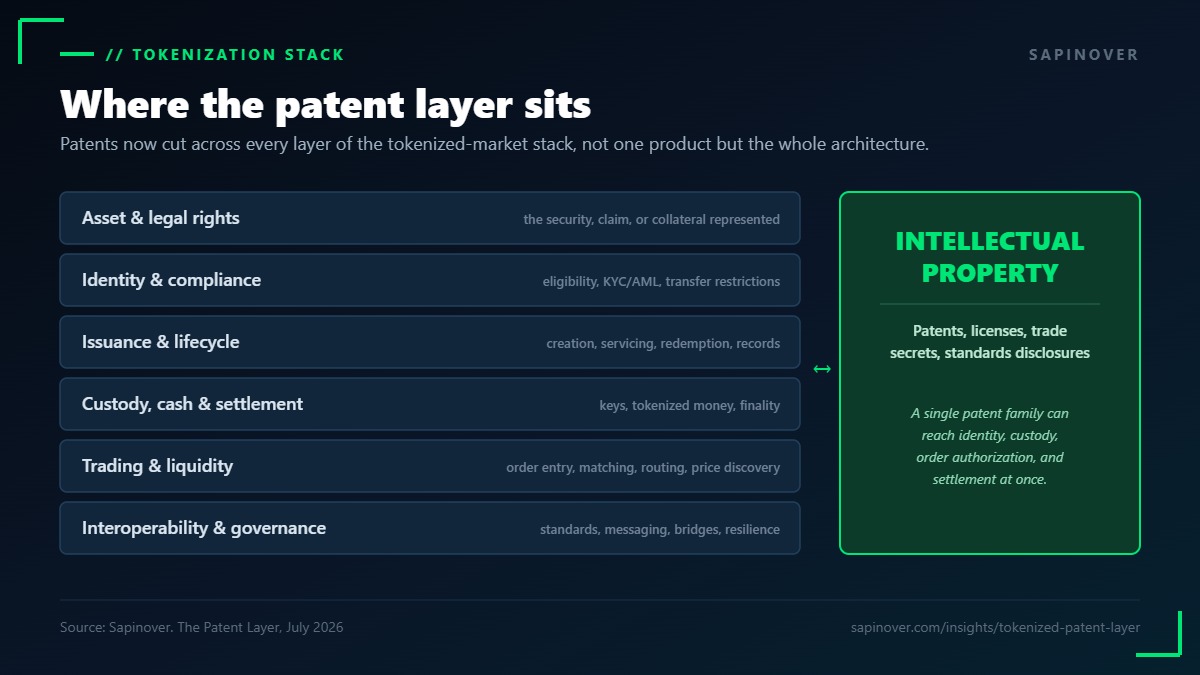
The tokenization stack is conventionally drawn in six layers: legal rights (what the token represents), identity and compliance (who may hold it), issuance and lifecycle (how it is created, serviced, and retired), custody, cash, and settlement (where it rests and how it moves against payment), trading and liquidity (how it changes hands), and interoperability and governance (how systems and rules connect). The tZERO campaign adds a seventh layer that sits across all of them: intellectual property.
A patent is an exclusionary right: the right to exclude others from practicing the claimed invention, not a right to practice it yourself. That asymmetry is what makes a patent layer structurally different from a regulatory layer. A regulation tells you what you must do; a patent tells you what you may not do without a license, and a single patent family can cut across identity, transfer control, custody, order authorization, and routing simultaneously. An architecture that is fully compliant with every securities regulation can still, in principle, read on someone's claims.
03The tZERO v. Securitize Case
The record below is limited to verified public events. It deliberately excludes anything not yet confirmed on the docket or in primary announcements.
- June 15, 2026tZERO publishes patent enforcement announcement
tZERO sends a cease-and-desist letter to Securitize (response deadline June 18) and publishes an announcement the same day, asserting US 11,216,802 and US 11,394,560 against Securitize's DS Protocol and Vault Registrar. The announcement identifies additional patents under investigation and states that products from “at least six” other market participants likely warrant further analysis. It describes a portfolio of 23 patent families and 105 patents worldwide.
tZERO announcement, tzero.com/news - June 22, 2026Securitize files declaratory-judgment complaint
Securitize files a declaratory-judgment complaint in the U.S. District Court for the District of Delaware, Case No. 1:26-cv-00722, assigned to Judge Gregory B. Williams. Caption: Securitize, Inc. v. tZERO Group, Inc. et al.
D. Del. docket 1:26-cv-00722
This timeline updates as the docket advances. Events are added only after verification against primary sources.
As of publication, the case remains at its earliest procedural stage. There has been no claim construction, no infringement or validity ruling, no damages award, and no injunction.
One detail reinforces the central thesis. On the same day as the tZERO announcement, a second and unrelated plaintiff, Liquid Rarity Exchange, LLC, filed its own patent-infringement complaint against Securitize in the same District of Delaware (Case No. 1:26-cv-00698). Two same-day patent actions from unrelated plaintiffs against a single tokenization platform is itself the point: this is an intellectual-property layer forming around the sector, not one company's isolated dispute.
One piece of market context belongs in the record, stated factually and without causal attribution: Securitize began trading on NYSE as SECZ on July 2, 2026, following its combination with Cantor Equity Partners II, and declined roughly 40% in its first week of trading. Public evidence does not isolate any single cause for that move, and this report does not attempt to.
Because early-stage patent disputes are routinely over-read, it is worth being precise about what the current record does and does not establish.
| Question | Established? |
|---|---|
| That tZERO has adopted an enforcement posture around its portfolio | Yes. The cease-and-desist and public announcement establish this directly. |
| That Securitize's products infringe any asserted patent | No. Infringement is an unresolved legal question for the court. |
| That the asserted patents are valid and enforceable | No. Validity has not been tested; patents carry a statutory presumption of validity that is rebuttable in litigation. |
| That tZERO “owns tokenization” as a category | No. Patents cover specific claimed inventions, not fields of activity. |
04Claim Language Controls
The single most common analytical error in reading patent disputes is treating a patent's title or its marketing description as its scope. Neither is. Under 35 U.S.C. § 271, direct infringement generally requires practicing every element of at least one claim, the all-elements rule. A system that implements nine of ten limitations of a claim does not infringe that claim. A system that does something that sounds like the patent's title, through a different mechanism, may not infringe at all.
This is also why the differentiation questions attached to each patent below matter more than the patent summaries themselves. Each question targets a specific claim limitation whose absence, if established, defeats infringement of that claim.
05Patent-by-Patent: The Verified Record
Six families dominate the enforcement picture: the two asserted patents, the three families the June 15 announcement identified as under investigation, and the continuation activity that shows the portfolio is still expanding. All bibliographic data below is verified against USPTO and Google Patents records.
ASSERTED · GRANTED JAN 4, 2022 · PRIORITY AUG 10, 2018US 11,216,802: the compliance-registry patent
The official title is a claim summary in itself: “Self-enforcing security token implementing smart-contract-based compliance rules consulting smart-contract-based global registry of investors.” Claim 1 recites a separate compliance smart contract consulted at transfer time and a smart-contract-based global registry of investors. The patent's dependent claims and description add specific Regulation A, Regulation D, and Regulation S indicators, frozen-account handling, PII-hash commitments, and AML/KYC features as configurable compliance rules; whether any given detail appears in claim 1 versus a dependent claim requires full claim review, so this report attributes those specifics to the patent's dependent claims and description rather than to claim 1.
- Does the architecture perform identity and compliance checks off-chain rather than via a smart-contract-based registry?
- Are compliance rules embedded in the token contract itself rather than in a separate compliance contract?
- Is the investor registry per-issuance or per-venue rather than global?
- How, if at all, are Regulation A/D/S indicators and frozen-account states represented?
ASSERTED · GRANTED JUL 19, 2022 · PRIORITY FEB 9, 2015US 11,394,560: the order-authorization patent
The '560 is the sleeper in the asserted pair, and its priority date is the reason: February 9, 2015, materially earlier than the 2018 compliance family and years before ERC-1400 or ERC-3643 existed. The claims center on a common identifier linking an exchange order and two accounts, the same key signing both the asset-transfer transaction and the order transaction, and dual signature verification performed before an exchange order is authorized. Any prior-art program aimed at this family has to search pre-2015 material, a far thinner record than the 2018-era compliance-token landscape.
- Does a common identifier actually link the order and the two accounts, or are they associated by other means?
- Do independent key domains sign the asset-transfer transaction and the order transaction?
- Is dual signature verification performed before order authorization, or is authorization decoupled from transfer signing?
UNDER INVESTIGATION · GRANTED SEP 24, 2024 · PRIORITY AUG 9, 2018US 12,099,996: the whitelist-verification patent
Issued from application US 2020/0051072 A1, with a priority date one day earlier than the '802. The claims cover whitelist membership plus private-key-association verification before a transfer of a self-regulating token executes. Where the '802 claims a registry architecture, the '996 reaches the wallet-level gating pattern that many permissioned-token systems use in some form.
- Is transfer gating performed by whitelist, or by a different eligibility mechanism?
- Is private-key association verified before transfer, or is key custody handled independently of transfer logic?
- Does the token self-regulate, or is enforcement external to the token contract?
UNDER INVESTIGATION · GRANTED JUL 18, 2023 · PRIORITY MAY 1, 2015US 11,704,733: the multi-asset creation patent (+ US 12,469,079)
Another 2015-priority family. Claim 1 of the '733 covers a signed multi-asset creation request, escrow of the underlying, minting of the token on that request, and an on-ledger record of the created asset. Redemption, release, and destruction mechanics are covered by the patent beyond claim 1. The family is not static: continuation US 12,469,079 granted November 11, 2025 (eight months before the enforcement campaign went public), which is the clearest signal in the record that the portfolio is under active expansion, with claims being drafted against a market that now exists.
- Is the structure single-asset rather than multi-asset?
- Is the underlying held in custodial escrow, or is the model non-custodial?
- Does a distinct second key control minting, or is mint authority unified with the requesting key?
UNDER INVESTIGATION · GRANTED SEP 6, 2022 · PRIORITY MAR 15, 2018US 11,436,673: the consolidated order book patent
The '673 reaches venue mechanics rather than token mechanics. Claim 1 covers a consolidated order book built from multiple external order books plus local order matching against it; the patent's dependent claims add custodial escrow of assets pending execution and failure-handling redirection when an external venue cannot fill. For trading venues and broker-dealers, this is the family whose claim language sits closest to how digital-securities markets actually route flow.
- Is the order book venue-local rather than consolidated across sources?
- Is routing non-custodial, with assets never escrowed by the router?
- Is there failure-handling redirection, or do unfilled orders simply expire?
PORTFOLIO · FOUR ADDITIONAL VERIFIED GRANTSThe wider portfolio
Beyond the six families above, the verified portfolio includes US 10,937,083 (granted March 2, 2021; priority July 3, 2017), covering decentralized fair ordering and matching of transactions; US 10,831,902 (granted November 10, 2020), covering time-centric Merkle hash tree data verification, known as TOME; US 10,552,829 (granted February 4, 2020; priority May 26, 2015), covering obfuscation of intent in transactions; and US 12,348,621 (granted July 1, 2025; priority February 26, 2020), covering secret splitting with verification metadata. None of these has been asserted, but together they show the portfolio's breadth: matching, data integrity, transaction privacy, and key management, in addition to compliance and custody.
06Live Patent Inventory
The table below is served from Sapinover's verified patent inventory and reflects the ten records examined in this report.
| Patent | Title | Subject area | Grant | Priority | Relevance | Status |
|---|---|---|---|---|---|---|
| US 11,216,802 | Self-enforcing security token implementing smart-contract-based compliance rules consulting smart-contract-based global registry of investors | Compliance & transfer control | Jan 4, 2022 | Aug 10, 2018 | High | Asserted |
| US 11,394,560 | Common identifier linking exchange orders and asset-transfer transactions with dual signature verification | Order authorization & key linkage | Jul 19, 2022 | Feb 9, 2015 | High | Asserted |
| US 12,099,996 | Whitelist and private-key-association verification for transfers of a self-regulating token | Transfer verification | Sep 24, 2024 | Aug 9, 2018 | Medium-High | Under investigation |
| US 11,704,733 | Signed multi-asset creation requests with escrow and second-key minting on a distributed ledger | Asset creation & custody | Jul 18, 2023 | May 1, 2015 | High | Under investigation |
| US 12,469,079 | Continuation in the multi-asset escrow and minting family of the '733 patent | Asset creation & custody | Nov 11, 2025 | May 1, 2015 | Medium-High | Under investigation |
| US 11,436,673 | Consolidated order book with custodial escrow, order aggregation, and external routing | Trading & routing | Sep 6, 2022 | Mar 15, 2018 | Medium-High | Under investigation |
| US 10,937,083 | Decentralized fair ordering and matching of transactions | Matching & ordering | Mar 2, 2021 | Jul 3, 2017 | Medium | Portfolio |
| US 10,831,902 | Time-centric Merkle hash tree data verification (TOME) | Data verification | Nov 10, 2020 | N/A | Medium | Portfolio |
| US 10,552,829 | Obfuscation of intent in transactions | Transaction privacy | Feb 4, 2020 | May 26, 2015 | Medium | Portfolio |
| US 12,348,621 | Secret splitting with verification metadata | Key management | Jul 1, 2025 | Feb 26, 2020 | Medium | Portfolio |
07Beyond tZERO: The Wider Patent Field
The tZERO campaign is the most visible dispute, not the only one. As tokenization becomes market infrastructure, patents are becoming a control layer across issuance, contract orchestration, platform functionality, and legacy assertion. The most useful way to read the wider field is by verified enforcement reality and functional layer, not by treating every patent holder as equally consequential.
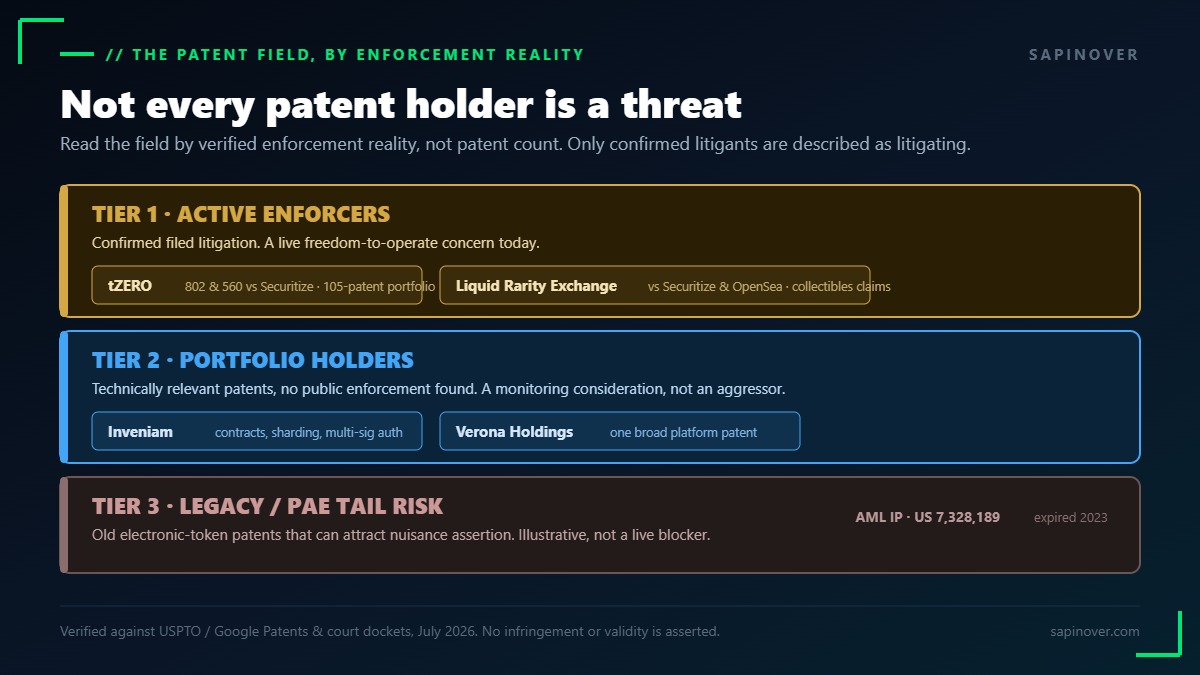
Liquid Rarity Exchange is a confirmed second enforcer. As covered above, RarityX filed against Securitize on June 15, 2026 (D. Del. 1:26-cv-00698). That was not its first suit: it previously asserted US 10,825,090 against OpenSea (S.D.N.Y. 1:24-cv-07651, filed October 2024), which was dismissed without prejudice in May 2025 after a settlement in principle, with no damages award or merits ruling. Its patents (10,825,090; 8,015,069) are rooted in rarities, collectibles, art-asset pools, and fractional ownership rather than a general regulated-securities stack. It is an active and litigious owner whose claim scope may be narrower than its enforcement framing suggests.
Two names are technically relevant portfolio holders, not enforcers. Inveniam Capital Partners holds a deeply technical, blockchain-native portfolio: digital-contract execution (US 11,276,056), transactional sharding (US 11,989,208), and identity-based accounts with key books and multi-signature authorization (US 12,137,179). No public enforcement activity was identified; this is a portfolio-monitoring name for platforms doing multi-party approvals, complex transaction decomposition, or on-chain/off-chain contract orchestration. Verona Holdings SEZC holds at least one issued broad tokenization-platform patent (US 12,271,876, granted April 2025) with continuation activity around token-linked real-world items, redemption, and workflow orchestration; portfolio significance is verified but no public enforcement record was found. It functions as a monitoring name, not an aggressor.
Legacy assertion is a different animal. Older, pre-blockchain electronic-token patents can attract nuisance assertion. AML IP LLC's US 7,328,189 is one illustration, but it is a useful cautionary example only, not a live constraint: the patent expired in July 2023 and predates blockchain, and AML IP's actual litigation targets retail and point-of-sale commerce rather than blockchain asset tokenization.
| Owner | Patent | Title | Status | Posture | Risk label |
|---|---|---|---|---|---|
| Liquid Rarity Exchange | US 10,825,090 | Rarity trading legacy protection and digital convergence platform | Granted Nov 3, 2020 | Active enforcer | Active, but narrower than framed |
| Liquid Rarity Exchange | US 8,015,069 | System and method for asset utilization | Granted Sep 6, 2011 | Active enforcer | Active, but narrower than framed |
| Inveniam Capital Partners | US 11,276,056 | Digital contracts in blockchain environments | Granted Mar 15, 2022 | Portfolio holder | Technically relevant, no public enforcement found |
| Inveniam Capital Partners | US 11,989,208 | Transactional sharding of blockchain transactions | Granted May 21, 2024 | Portfolio holder | Technically relevant, no public enforcement found |
| Inveniam Capital Partners | US 12,137,179 | Systems and methods for processing blockchain transactions | Granted Nov 5, 2024 | Portfolio holder | Technically relevant, no public enforcement found |
| Verona Holdings SEZC | US 12,271,876 | Tokenization platform | Granted Apr 8, 2025 | Portfolio holder | Broad platform patent, litigation posture unverified |
| AML IP LLC | US 7,328,189 | Method and apparatus for conducting electronic commerce transactions using electronic tokens | Expired Jul 31, 2023 | Legacy / illustrative | Expired; illustrative of PAE tail risk only |
Other names circulate in the tokenization patent conversation (including Winklevoss/Gemini-related patents, Veritaseum, DeFi/AMM patent claims, and the large tokenization estates of financial incumbents), but they could not be pinned to specific patent numbers, courts, and claim language at the same evidentiary standard as the records above in this pass, so they are monitored rather than asserted here. They are not in the same evidence tier as the confirmed and portfolio-verified holders in the table.
Mapped onto the freedom-to-operate categories in the playbook below, the four layers look like this: issuance and compliance is tZERO's territory, contract orchestration is Inveniam's, platform functionality is Verona's (with Liquid Rarity straddling platform and legacy), and legacy/PAE tail risk is AML IP's, a map of where to look, not a ranking of who to fear.
08Standards and Prior Art
The chronology is the uncomfortable part for the open-standards community. ERC-3643, the permissioned-token standard whose architecture (on-chain identity registries, compliance contracts consulted at transfer time) overlaps conceptually with the '802 family, was proposed on July 9, 2021 and now carries Final status. The '802's priority date is August 10, 2018. ERC-1400's originating GitHub issue #1411 was opened September 13, 2018, about a month after the '802 priority date. And the '560 and '733 families reach back to February and May 2015, years before either standard existed.
Two caveats keep that chronology from being a conclusion. First, conceptual overlap is not infringement: whether any ERC-3643 implementation reads on the '802 claims is an implementation-specific, element-by-element question, not a standards-level one. Second, priority dates define where prior art must be found, not whether it exists. A serious prior-art program against these families must search the 2014-to-mid-2018 record: early security-token pilots, public repositories, transfer-agent systems, and pre-standard permissioned-token experiments. That record is thinner than the post-2018 landscape, but it is not empty.
The standards arrived after the filings. That is precisely why the prior-art search has to look where the standards are not.
09Legal Vulnerabilities
An asserted patent is a set of litigation questions, and the defense side of this dispute has a conventional sequence to work through. Non-infringement and claim construction come first: most patent cases are won or lost on how the court construes disputed claim terms, and the differentiation questions in Section 05 are, in effect, a preview of the construction fights.
Second is subject-matter eligibility. Alice Corp. v. CLS Bank, 573 U.S. 208 (2014), established the two-step framework under Section 101: is the claim directed to an abstract idea, and if so, does it contain an inventive concept beyond the idea itself? Financial-computer-implementation patents have fared poorly under Alice, and claims reciting compliance checks and registries on generic ledger infrastructure will face that framework squarely. It is a credible defense theory, not an automatic outcome. Courts have also upheld software claims that recite specific technical architectures, and the asserted claims here are more architectural than the typical Alice casualty.
Third are the classical validity grounds: anticipation under Section 102, obviousness under Section 103, and definiteness, written description, and enablement under Section 112. The 2015-priority families narrow the 102/103 search window; the 2018 families face a richer prior-art landscape.
Finally, remedies. eBay v. MercExchange, 547 U.S. 388 (2006), ended automatic injunctions in patent cases: a prevailing patentee must satisfy the traditional four-factor equity test, and the public-interest factor carries real weight where the accused systems are regulated financial infrastructure with live issuances and investor holdings on them. Even a clean win on liability does not mechanically translate into shutting an accused platform down.
10What It Means for Market Participants
The immediate effect of an enforcement campaign is not any court outcome: it is the diligence burden it imposes on everyone in the blast radius while the outcome is pending. That burden distributes unevenly.
| Participant | Exposure | Likely response | Net effect |
|---|---|---|---|
| Tokenization platforms | Direct: architecture-level overlap with asserted claim elements | FTO reviews, claim charts, design-alternative studies | Engineering roadmaps acquire a legal dimension |
| Asset managers & issuers | Indirect: vendor selection now carries IP diligence weight | Indemnity demands, multi-vendor strategies | Slower procurement, higher diligence cost |
| Transfer agents | Moderate: registry and compliance functions sit near claim language | Map on-chain registry features against claim limitations | Architecture choices become contract terms |
| Broker-dealers & ATSs | Moderate: order authorization and routing claims reach venue mechanics | Review matching, custody, and routing stacks | Venue build-vs-license decisions get harder |
| Custodians | Moderate: escrow, key management, and mint/burn lifecycle claims | Key-domain separation reviews, wallet architecture audits | Custody design becomes part of IP posture |
| Standards bodies | Structural: open standards do not confer patent immunity | Prior-art programs, defensive publication, disclosure policies | Standards work inherits a patent-clearance layer |
| Investors | Indirect: litigation uncertainty prices into platform valuations | IP diligence in venture and public-market analysis | An IP risk premium enters the sector |
Four structural consequences follow. An IP risk premium enters tokenization economics: legal clearance becomes a line item alongside compliance and audit. Architecture becomes legal strategy: the choice between an on-chain global registry and off-chain eligibility checks is no longer purely an engineering trade-off. Startups bear a disproportionate burden: a freedom-to-operate study and defensive filing program is a rounding error for an incumbent and a funding round for a seed-stage team. And all three of those push toward consolidation, toward platforms large enough to carry the legal overhead, license, or countersue.
Some commentators have compared broad early patent positioning in emerging infrastructure to early internet domain-name speculation; the comparison is imperfect (patents are examined rights granted in exchange for disclosure), and the market will judge through litigation outcomes and licensing behavior.
11The Freedom-to-Operate Playbook
For teams building in this space, the response to an enforcement campaign is a process, not a panic. The sequence below is the standard freedom-to-operate discipline, ordered:
- Architecture record. Produce an accurate, current description of how your system actually works (registries, keys, escrow, routing) before anyone maps claims against it.
- Family maps. Chart each relevant patent family: parents, continuations, pending applications, and foreign counterparts. A design-around against a granted claim can be recaptured by a pending continuation.
- Element-by-element claim charts. Map every limitation of every independent claim against the architecture record. This is the core artifact; everything else supports it.
- Prosecution history review. What the applicant surrendered to get the claims allowed constrains how broadly those claims can be construed.
- Prior-art search. Target the window the priority dates define: for these families, 2014 to mid-2018 security-token pilots, repositories, and transfer-agent systems.
- Design alternatives. For each claim element your system arguably practices, identify and cost the architecture that does not practice it.
- Contracts. Review vendor and customer agreements for IP indemnities, and negotiate them where absent.
- Defensive portfolio. File on your own innovations; defensive publication is the cheaper alternative where filing is not warranted.
- Escalation triggers. Define in advance what event (a letter, a filing, a licensing approach) moves the matter from monitoring to counsel.
| Architecture pattern | Indicative tier |
|---|---|
| Shared on-chain compliance registry consulted at transfer time | High |
| Wallet whitelist plus private-key-association checks before transfer | Medium-High |
| Same key signs both the asset-transfer transaction and the order transaction | High |
| Multi-asset escrow with mint/burn lifecycle under a second key | High |
| Non-custodial order aggregation and routing | Lower |
| Pure analytics and read-only data layers | Lower |
12Scenarios
Five outcomes bound the space. Note the last one: a confidential settlement (statistically the most common endpoint for patent litigation) is also the outcome that resolves the least for everyone who is not a party to it.
| Outcome | Market consequence | Innovation consequence |
|---|---|---|
| Broad tZERO win | Licensing regime across compliance-token architectures; consolidation pressure on smaller platforms; higher cost of entry | Design activity shifts toward architectures outside the claim perimeter; standards bodies forced into formal patent policies |
| Narrow win (limited claim constructions) | Targeted licensing on specific features; most architectures continue with modest design changes | Claim-chart discipline becomes routine; feature-level design-arounds proliferate |
| Non-infringement finding | Enforcement leverage weakens; platform valuations shed the near-term litigation discount | Architecture diversity validated; patent positioning shifts to future filings |
| Invalidation (Section 101/102/103) | Portfolio value reprices sharply; other holders reassess enforcement economics | Cumulative innovation proceeds with lower clearance overhead; prior-art programs gain standing |
| Confidential settlement | No public claim construction; uncertainty persists for every non-party, potentially the most durable-uncertainty outcome | FTO analysis stays speculative; the deterrent effect operates without judicial testing |
13The Market-Structure Sidebar
There is a detail in this dispute that connects it directly to the venue universe Sapinover tracks every day. tZERO is not only a patent holder: tZERO ATS, LLC is itself a FINRA-registered, SEC-reporting alternative trading system for digital securities, with a public Form ATS-N on EDGAR (CIK 1193821), and in 2025 it received FINRA approval to trade tokenized corporate debt. It is a non-NMS digital-securities venue: structurally a different animal from the NMS-equity overnight ATSs (BlueOcean, Bruce, Moon) whose tape we process daily, but a Form ATS-N filer all the same, with the same disclosure obligations and the same regulatory perimeter.
That matters because the two threads of market evolution this site covers are converging on the same end state. Extended-hours NMS trading is stretching the regular-session equity market toward continuous operation: NSCC 24x5 clearing live, SIP extended hours approved for December 2026. Tokenized settlement is building continuous, programmable settlement from the other direction. The end state both point at is the same: markets that do not close, settling on rails that execute rules as code. The overnight ATS tape is the empirical preview of the demand side; the tokenization stack is the infrastructure bid for the supply side.
The patent layer now sits across both. The families examined in this report claim transfer control, order authorization, custody lifecycle, and routing: mechanics that any continuous, programmable market needs, whether it grows out of an NMS venue extending its hours or a tokenization platform extending its asset coverage. Whoever holds enforceable claims on those mechanics holds a position in both futures. That is why a patent dispute between two digital-securities firms belongs in a market-structure publication: it is not a sideshow to the 24/7 transition. It is a fight over who owns the toll booths on the road to it.
Tokenized markets now have an IP layer, and it arrived the way legal layers usually do: suddenly, retroactively, and with priority dates that predate the standards everyone built on. Nothing has been decided: two patents asserted, zero rulings, a Delaware docket at its earliest stage.
But the diligence burden is already real. The architecture questions in this report (where the registry lives, which keys sign what, who holds escrow, how orders are authorized) are now legal questions as much as engineering ones. Teams that answer them deliberately, with claim charts rather than assumptions, will carry the patent layer the way mature industries always have: as a cost of doing business, not an existential surprise.
- tZERO announcement of patent enforcement action, June 15, 2026 (tzero.com/news).
- U.S. District Court for the District of Delaware, docket 1:26-cv-00722, Securitize, Inc. v. tZERO Group, Inc. et al.
- Google Patents records: US 11,216,802; US 11,394,560; US 12,099,996; US 11,704,733; US 12,469,079; US 11,436,673; US 10,937,083; US 10,831,902; US 10,552,829; US 12,348,621.
- EIP-3643 (T-REX: Token for Regulated EXchanges), proposed July 9, 2021, status Final (eips.ethereum.org).
- ERC-1400 originating GitHub issue #1411, opened September 13, 2018 (github.com/ethereum/EIPs).
- Alice Corp. v. CLS Bank International, 573 U.S. 208 (2014).
- eBay Inc. v. MercExchange, L.L.C., 547 U.S. 388 (2006).
- SEC staff, Statement on Tokenized Securities, January 28, 2026 (three divisions).
- McKinsey & Company, tokenization market sizing, June 2024.
- Citi Institute, “Tokenization 2030,” June 2026.
- Standard Chartered and Synpulse, tokenized real-world asset demand study, June 27, 2024.
- USPTO, patent essentials and 35 U.S.C. §§ 101, 102, 103, 112, 271.
This report is independent industry research. It is not legal advice and is not investment advice. A freedom-to-operate opinion requires qualified patent counsel and confidential product evidence; nothing in this report substitutes for either.
Sapinover holds no position in, and has received no compensation from, any company mentioned in this report. Nothing herein states or implies that any product infringes any patent or that any patent is invalid; those are unresolved legal questions.
Claim summaries are paraphrases prepared for readability: verify against official patent records before any legal reliance. Facts are as of July 13, 2026.