

// FRONTIER · DIGITAL ASSETS & TOKENIZATION
Structure for a market that never closes.
Tokenized securities, real-world-asset rails, and digital-venue microstructure, mapped with the same lens we point at the overnight tape. Transparent by design, auditable by default.
// THE THESIS
Overnight markets never close. Tokenization makes that permanent.
Our overnight work already covers the assets that never close. Tokenization extends market structure into 24/7 infrastructure, and transparency is native to it. We bring the microstructure lens that crypto-native shops lack: how things actually trade, settle, and price.
The overnight tape is a window into behavior that traditional market hours obscure. On-chain venues open that window permanently. The methodology transfers. The discipline transfers. The commitment to verified, auditable data is already built in.
// WHAT WE MAP
Tokenized Securities
Market structure for tokenized equities and real-world assets: how they trade, settle, and price. The same microstructure lens we train on overnight ATS venues, applied to on-chain instruments.
Real-World-Asset Rails
The always-on settlement and venue infrastructure of the next market. How RWA protocols clear, how liquidity pools form, and where friction hides in the pipe.
Digital-Venue Microstructure
The same venue and flow analysis we run on ATS, pointed at digital-asset venues. Spread dynamics, order flow composition, and fee structure from an institutional vantage point.
Transparent by Design
On-chain, auditable, verifiable. Transparency is the native property of this asset class, not a bolt-on. We map it as a structural feature, not a marketing claim.
// WHY US
The overnight thesis, extended
We already cover the assets that trade when traditional markets are closed. Tokenization stretches market hours to 24/7 infrastructure. Our overnight data and methodology travel naturally into this space.
An institutional lens crypto-native shops lack
Crypto-native analysts read on-chain data well. They rarely read microstructure. We bring 20+ years of buy-side execution research, ATS economics, and venue analysis to a domain that has needed it.
Auditable and verifiable by default
On-chain data is public, timestamped, and immutable. We treat that as a gift: every claim we make about a digital venue can be independently verified. That is the standard we hold ourselves to everywhere.
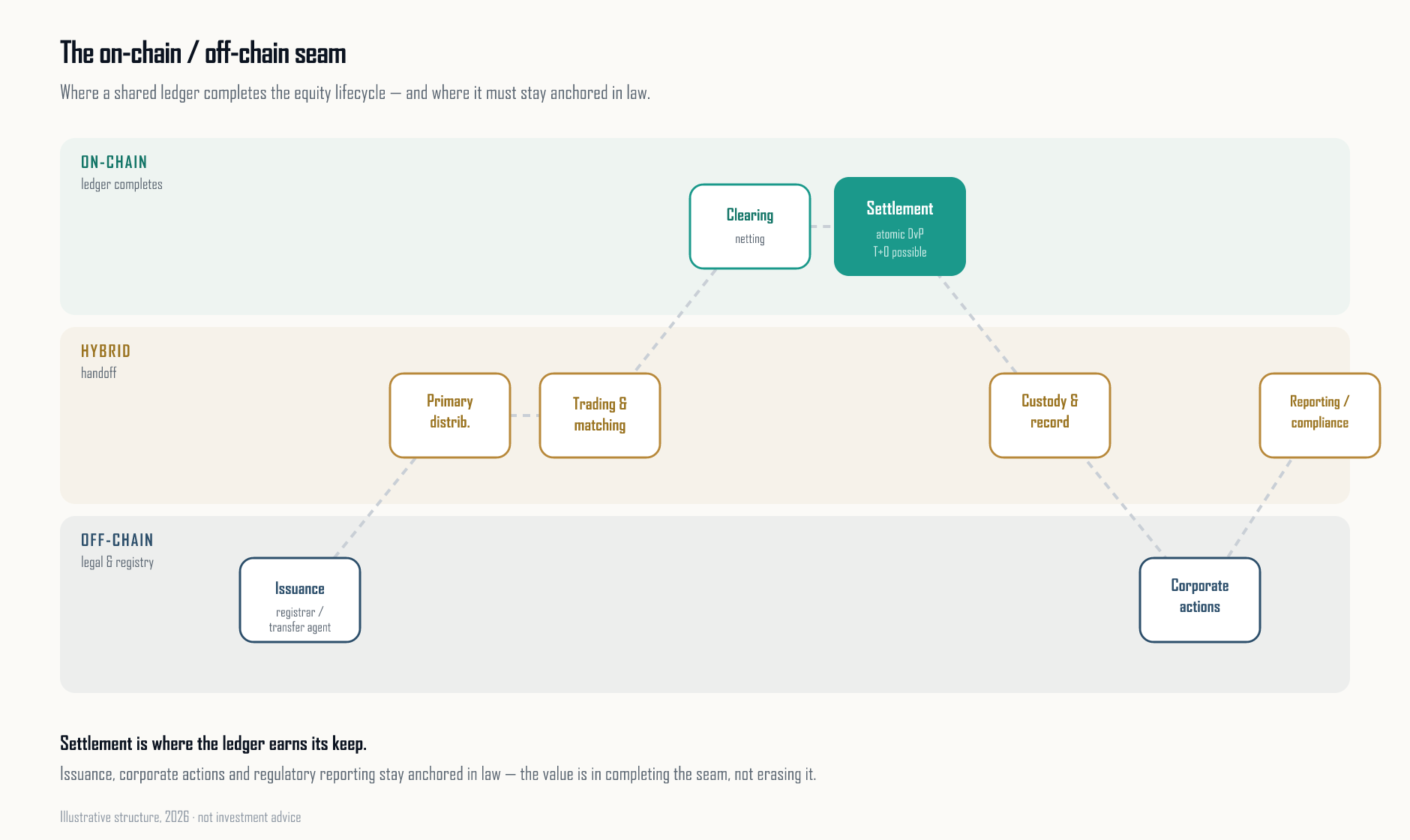
// WORKING QUESTIONS
15 questions the tokenized equities market has not answered yet.
These questions come from the working conversations happening inside standards bodies, trading desks, and market-structure committees. They are not theoretical. Each one names a gap that practitioners are navigating right now.
AToken design: what does the holder actually hold?
Is the token a direct legal record of ownership, or an entitlement against an intermediary?
When a token changes hands, does title move, or does a claim against a custodian’s omnibus position move? The entire risk profile follows from that one answer.
Where does the authoritative register live: on-chain, or is the chain a mirror of an off-chain transfer-agent record?
If it mirrors an off-chain register, what reconciles the two, and what happens when they disagree?
Is the design legally cognizable under UCC Article 12, or does it rely on Article 8 entitlements through a securities intermediary?
Which one, and why was it chosen?
What corporate-action and proxy logic is encoded in the token versus handled off-chain?
And who is liable when an automated dividend or vote fails to propagate?
BSettlement topology: the trilemma
Does anyone actually want gross, trade-by-trade atomic settlement for institutional flow?
Netting compresses obligations by roughly 98 percent before anything moves. Atomic gross throws that away. So what is the real target: atomic finality, or atomic finality of a netted position?
If we net on-chain, who bears the counterparty risk during the netting window?
Full collateralization brings the capital cost back. A mutualizing entity rebuilds the central counterparty in code. Which trade-off is each asset class willing to make?
Should settlement cadence be a configurable parameter rather than a fixed property of the rail?
Continuous, hourly, or end-of-day. If cadence is a dial, what governs the choice per asset class and per counterparty?
Where does collateral mobility unlock value first: repo, margin, or securities lending?
What has to be true legally for a tokenized asset to be accepted at full backing value rather than haircut for uncertainty?
CFIX and the messaging seam
What is the FIX-equivalent instruction set for an on-chain to off-chain handoff?
“Settle this net, on this cadence, with this collateral arrangement, atomic at the boundary” has to be expressible in a standard message, or every integration becomes bespoke.
Do we extend existing FIX message types to carry settlement-topology and on-chain-finality semantics, or does this need a new layer alongside FIX?
How do we represent settlement finality and legal-record status in a message so a traditional counterparty and an on-chain counterparty agree on what “done” means?
What is the minimum data model for an asset to be recognized across venues without forcing everyone onto the same chain?
Issuer, register location, backing attestation, finality rule.
DNeutrality and market structure
Who runs the settlement rail, and can it be neutral?
A venue, issuer, or custodian that also clears has a channel conflict. The history of DTCC, SWIFT, and ACH says the winning layer is the neutral one. Is the industry building toward that, or toward many proprietary ledgers that do not interoperate?
As more issuers tokenize, does each new venue connection raise or lower the integration burden for a broker-dealer?
If it raises it, we are building fragmentation, not infrastructure.
What is the standards body’s role versus the market’s?
Does FIX map the seam, or does it also need to arbitrate who is allowed to be the neutral settlement utility?
* Starred questions are suggested door-openers for working-group discussion.
// JOIN THE CONVERSATION
Add your perspective.
Pick a question above or respond generally. Responses are reviewed before publishing. Your email is never shown publicly.
// PARTNER EARLY
This theater is in active development.
The infrastructure of the next market gets built with partners who are in early. If you are building tokenization rails or a digital venue, let us map it together.